Dryer vent cleaning in Ahwatukee, AZ
One village, one price. $99 flat anywhere in Ahwatukee, from a 1978 single-story off Warner to a custom hillside build against the mountain.
Calls answered 7am to 8pm · same-day service usually available
Street address and a date and time that suits you. That is the whole booking.
Three zip codes, one price
Find your neighborhood
The work differs meaningfully across the village, so there is a page for each of the main areas covering when it was built, how the run is likely configured, and what we typically find.
The Foothills and Lakewood · Mountain Park Ranch · Club West · Original Ahwatukee · Foothills Reserve and Calabrea · Ahwatukee Custom Estates and the hillside lots
Four eras, four different jobs
The seventies and early eighties
The original developments north of Elliot. Single story, compact, short runs up eight feet and straight out the side wall. Mechanically the simplest work there is, and frequently never opened in fifty years.
The mid eighties through the nineties
Mountain Park Ranch and The Foothills and Lakewood. This is where two-story plans took over and the laundry moved upstairs, which put the termination on the roof. Long runs, several bends, thirty-odd years of accumulation.
The nineties into the 2000s
Club West and Foothills Reserve. Newer ductwork, but heavy dust exposure on the west side and a laundry closet problem in the newest builds where the transition hose gets crushed flat behind the machine.
The custom lots, all eras
Individually built homes on individually shaped ground. The duct went wherever the builder decided, once, decades ago. We trace it rather than guess.
What the mountain adds
Wildlife
Thousands of acres of preserve along the northern boundary means more birds looking for nesting sites than a built-out suburb produces. An unguarded cap is prime territory from February onward. Full page on it.
Dust
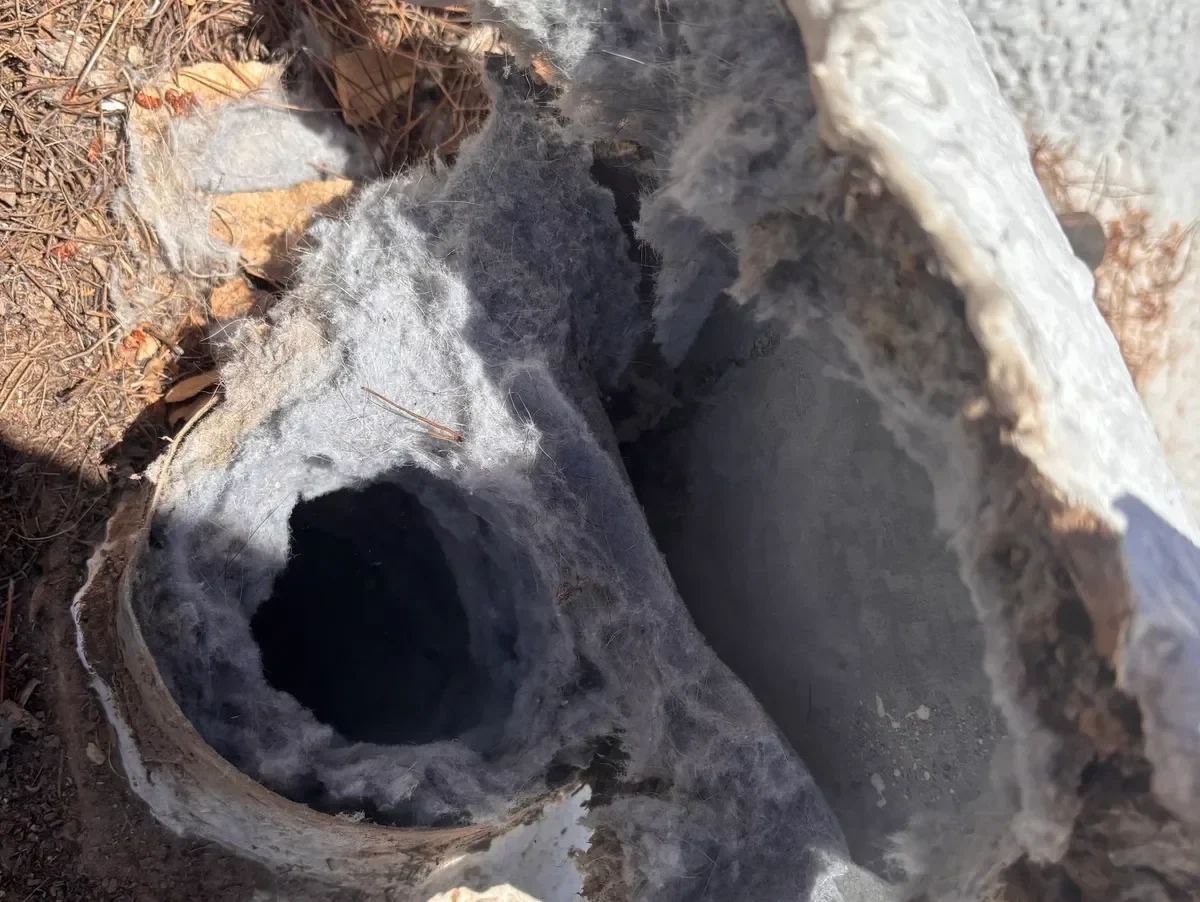
Open desert generates fine airborne material continuously, and it binds with lint into something denser and harder to shift than lint on its own. The boundary streets get the most of it.
Slope
Homes built to follow the terrain have duct routes that do not match the assumptions you would make on flat ground. Horizontal sections through floor structures collect material in the middle of the run, which is exactly where a single-ended clean fails to reach.
How we do it
- Work out what you have. We trace the route, look at the exterior cap or the roof hood, and check the flexible section behind the appliance. On the hillside lots especially, the run is often not where people assume it is.
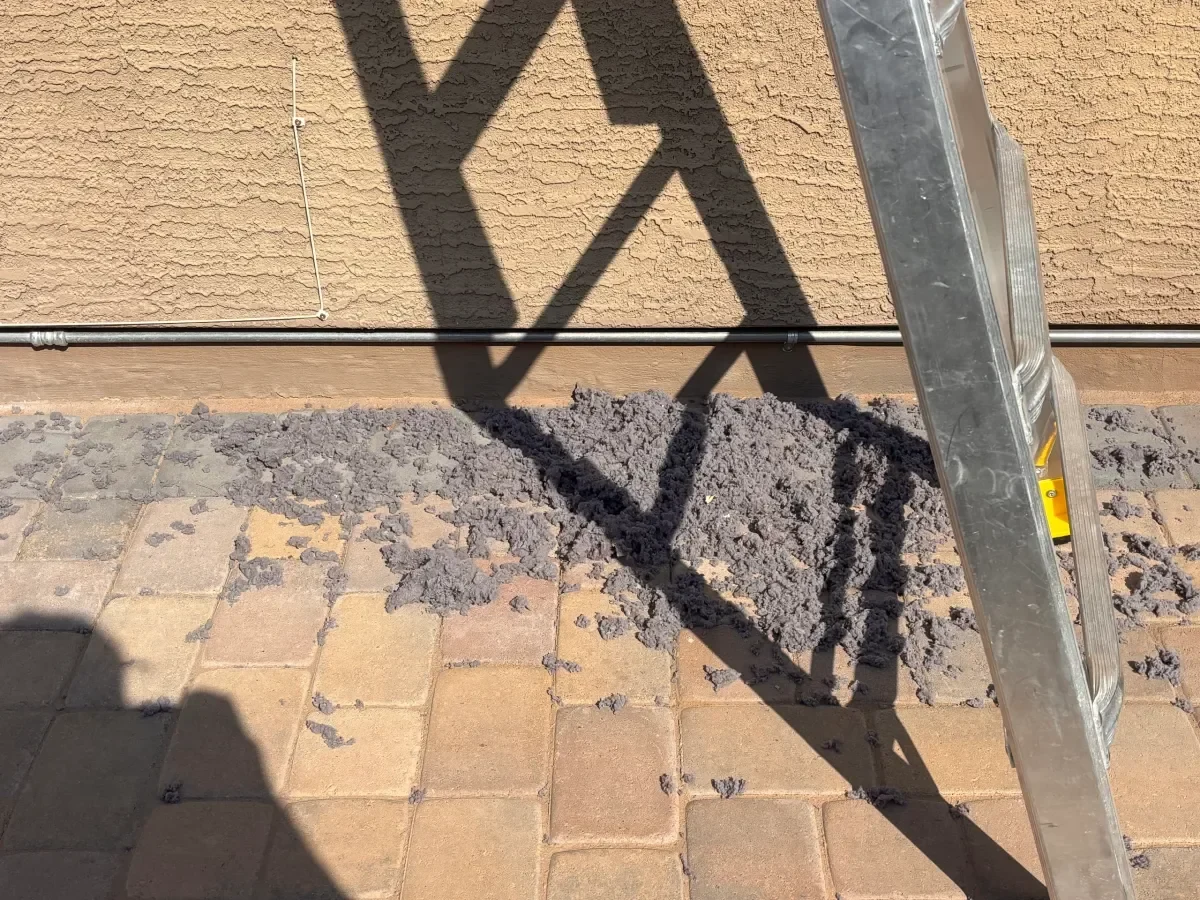
- Outside first, machine running. The dryer stays powered up the entire time we are at the termination, so its own exhaust pushes whatever we loosen out and clear of the duct instead of letting it settle back into the run. It throws lint around outside. Clearing that up is part of the job.
- Then inside. Power off, hose uncoupled, appliance drawn away from the wall. The brush goes into the vent from this end, the freed material comes down toward us, and the vacuum takes it out of the cavity.
- Two ends when the run earns it. A long route with several bends gets worked from both directions, since a brush entering from one side never properly reaches the far half. A short straight run does not, and we will say so instead of inventing work.
- Back together, and you look at it. Appliance reconnected and run, and the material we pulled out left in front of you.

How often it needs doing
Ten months is the interval for an ordinary household. Treat that as a maintenance schedule rather than a nudge.
- Every 10 months in a typical Ahwatukee home
- Every 4 to 6 months where the house is full and the machine runs most days
- Monthly on commercial equipment
Plenty of people here treat a slow dryer as the cue to call somebody. By then you are not approaching the interval, you went past it roughly a year ago. Slow drying is what surfaces after months of restricted airflow have already been working on the appliance, not the point at which the problem starts.
Questions about service in Ahwatukee
Do you cover the whole village?
All three zip codes at one price: 85044, 85045 and 85048. From the original streets off 48th Street through to Foothills Reserve on the preserve boundary. No call-out fee and no zone pricing.
Do you go over the mountain?
No. Ahwatukee Foothills is the entire service area. A company covering the whole Valley treats a trip out here as an inconvenience and prices accordingly. We do not, because it is the only place we go.
Do you handle HOA and management company work?
Yes. Ahwatukee has a lot of active associations and we deal with them regularly. We can invoice a management company directly and do several properties in one visit where they are close together.
What about the hillside and custom homes?
Those are some of the more interesting jobs we do, because the run genuinely cannot be predicted from outside. Same $99 regardless. Charging more for a house that turns out to be complicated is a way of penalising people for their architecture.
Does backing the preserve change anything?
It does, in two ways. More wildlife interest in an unguarded cap, and more airborne dust working into the duct and the screen cavity. Both shorten the sensible interval, which is why we suggest four to six months rather than ten for boundary homes.
My neighborhood is not listed. Do you still come?
If the address is in Ahwatukee, yes. The neighborhood pages exist because the work genuinely differs between them, not because they are the only streets we work.
Calls answered 7am to 8pm · same-day service usually available
$99 flat, roof included, anywhere in the village.