Professional dryer vent cleaning in Ahwatukee, AZ
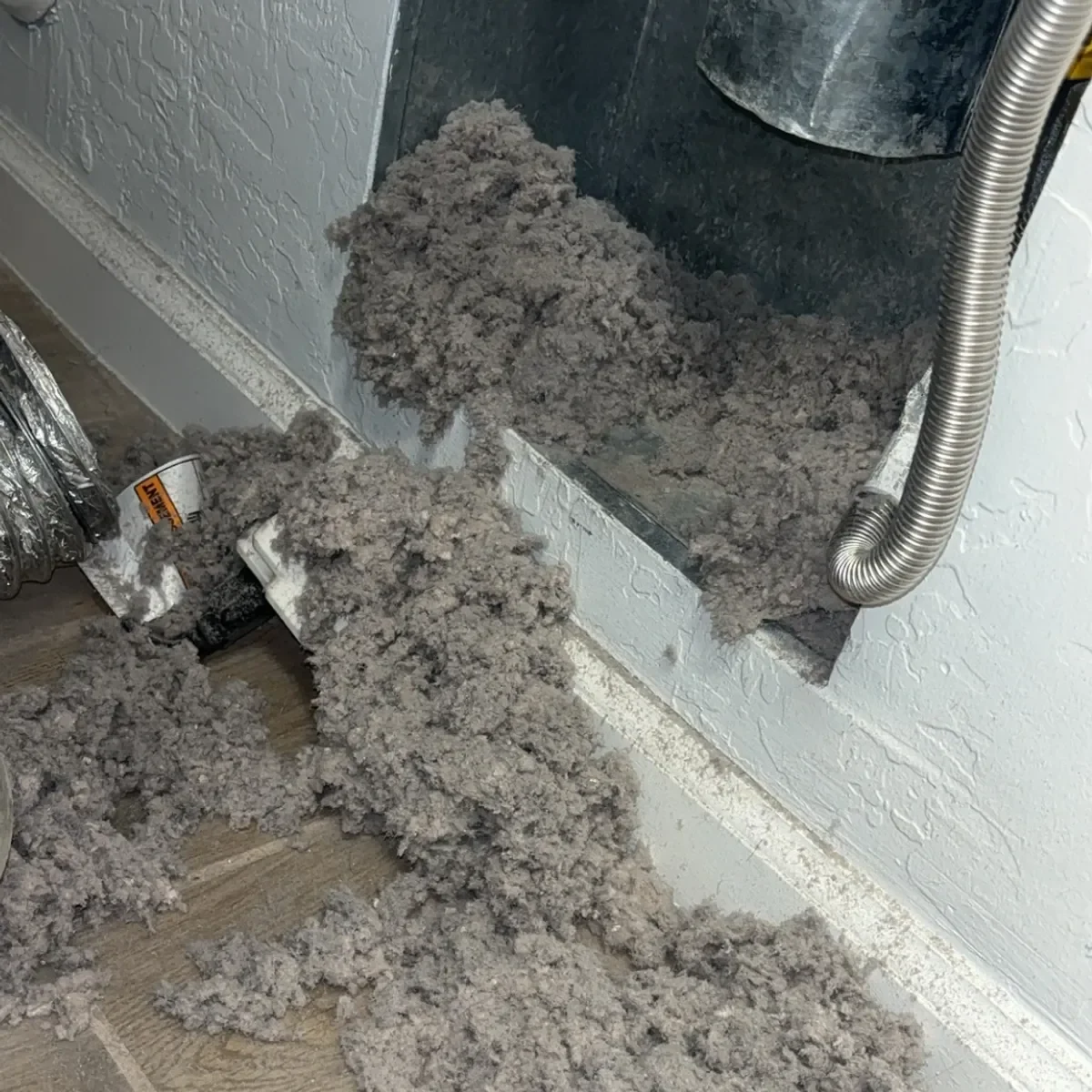
$99 flat. Roof terminations at no extra charge. Worked from both ends when the run calls for it, and the material we take out gets left where you can look at it.
Calls answered 7am to 8pm · same-day service usually available
Street address and a date and time that suits you is all we need to get you in the diary.
- Address and a preferred date and time. Nothing else needed. We are not going to put you through a questionnaire about your appliance.
- The price comes on that call. $99 for a standard vent with roof access in it. Anything genuinely out of the ordinary about your setup, you hear the number then rather than once we are parked at the kerb.
- We book you in. Most homes land inside the same week, and same-day is often available if you catch us early. Phone is answered 7am to 8pm.
- The rest is ours. We shift the appliance, clear the run, put it all back, run it, and leave the pile where you can see it.
Is the dryer posting an error code?
Begin here, because it is the single most dependable indicator available and hardly anyone gets told about it.
A dryer throwing a code is the vent about 95 percent of the time.
Current machines are good at catching this. The control board keeps track of cycle length and exhaust temperature, and when a restriction pushes those two readings out of agreement it posts a fault or ends the cycle early. Every brand labels it differently. The condition underneath is always identical, which is that the exhaust cannot get out of the building.
What generally follows is an appliance technician, a service charge, and the news that the dryer is in good order and the duct is packed. It is a common sequence and an avoidable one. Look at the vent before paying anybody to open up the machine.
Older equipment has no such monitoring. It simply runs hot and takes two cycles until a component gives out, which is a large part of why the neglect in the original Ahwatukee housing goes unnoticed for so long.
Ahwatukee is its own place, and its vents behave accordingly
Three things about this village shape what we find in its ductwork, and none of them apply to the flat subdivisions east of the mountain.
It sits against the largest municipal park in the country
South Mountain Park runs along the entire northern edge of Ahwatukee, and a lot of these neighborhoods back directly onto it. Thousands of acres of undeveloped desert next door means more wildlife looking for somewhere to nest and more airborne dust than you get in the middle of a built-out suburb. Both end up in dryer vents.
It is built on a slope
Ahwatukee steps up toward the mountain, and the housing was built to follow the ground. Split levels, sunken rooms, garages half a story down, and custom lots that do whatever the terrain required. The duct route is frequently not where you would guess from the street, which is why we trace it rather than assume.
It is geographically self-contained
The mountain separates this village from the rest of Phoenix, and there are only a handful of ways in. That gives Ahwatukee a distinct identity, and it also means a company covering the whole Valley treats a trip here as an inconvenience. We only work here, so it is not one.
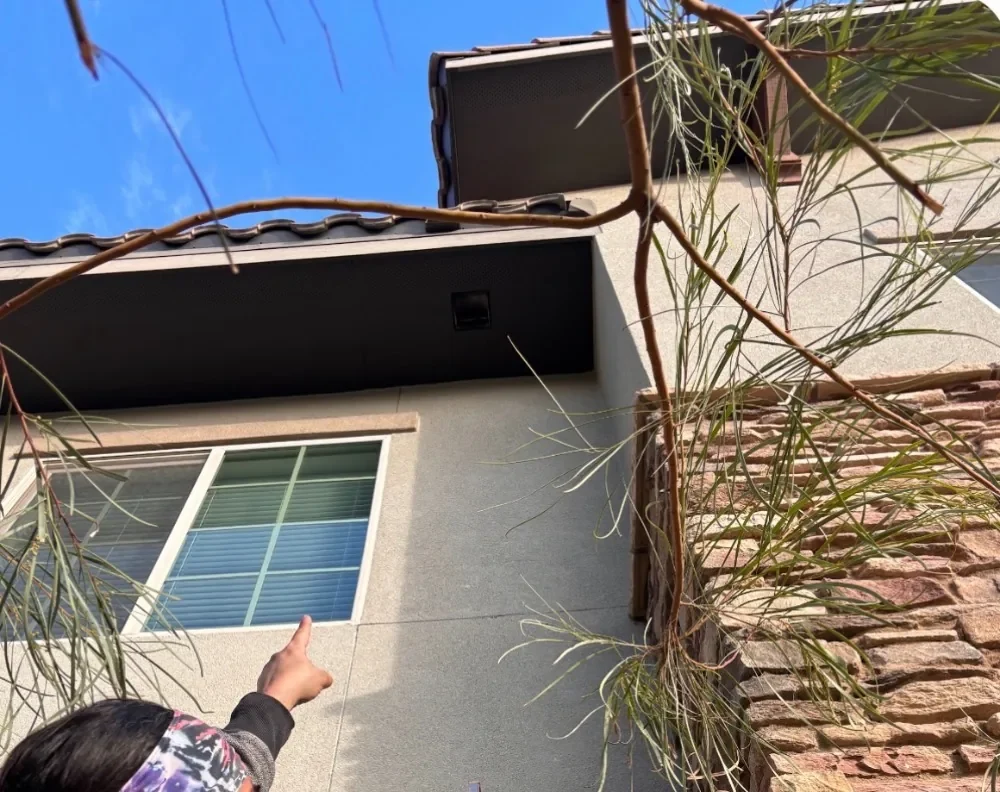
What the desert does to a dryer vent
Monsoon is when it surfaces
Humidity climbs through July and August, and an appliance already labouring against a partial obstruction simply stops coping. Nothing changed inside the duct. The restriction had been building since winter. The weather just removed whatever margin you had left.
Preserve dust is different from house dust
Fine caliche material blows off open desert continuously, and the homes on the preserve boundary get the most of it. It works into the screen cavity and the duct, where it binds with lint into something denser and considerably harder to shift than lint alone.
Fifty summers on a plastic flapper
The exterior flaps on the original seventies housing have been in full unshaded sun for half a century. They deform, the hinge seizes, and they stop moving. Some of the ones we find have not closed since the nineties.
Tile roofs are the rule here
Nearly all the two-story stock sits under concrete tile, which fractures where weight lands wrong, and a fractured tile becomes water ingress the first time a storm actually delivers. It is also why plenty of companies quote a roof vent and then discover a scheduling problem.
Wildlife on the boundary
Backing the preserve is the reason people buy here. It also means an unguarded cap on a boundary street is about as attractive a nesting site as exists in the Valley, from roughly February onward.
What an obstructed vent is actually doing
A dryer is better thought of as an air mover than a heater. It draws room air in, warms it, sends it through the drum where it picks up moisture from the load, and pushes it out through the vent. The whole process depends on that last step working.
Restrict the duct and the moisture has nowhere to go, so it stays in the drum. That is the symptom you notice. Three worse things are happening behind it.
The appliance is destroying itself
There is a thermal fuse in every dryer meant to cut power before things overheat. A restricted duct has it intervening routinely while the heating element works well outside its intended range. Machines that fail at six or seven years have very often been finished off by a duct nobody opened.
A fire risk is accumulating
The figures below come from the National Fire Protection Association rather than from us. In their data, failure to clean is the largest single contributing factor in dryer fires, and lint is the material most likely to ignite first.
Source: National Fire Protection Association, Home Fires Involving Clothes Dryers and Washing Machines.
Moisture is going into the structure
Every load has to send its humidity somewhere. Blocked, it backs into the wall cavity. In the older Ahwatukee housing we also find joints that were taped rather than fixed, with the tape long since gone, which means that has been happening for years.
Signs it needs doing
- The dryer is posting an error code, which points at the duct roughly 95 percent of the time
- Clothes come out warm but still damp at the end of a full cycle
- Two cycles have become normal for one ordinary load
- The laundry room gets noticeably hot while the machine runs
- A burning smell, or a musty one, during a cycle
- The screen is catching noticeably less than it used to
- The machine shuts itself down partway through
- The flap outside barely moves, or does not open
- It has been over ten months, or nobody has ever done it
How we do it
- Work out what you have. We trace the route, look at the exterior cap or the roof hood, and check the flexible section behind the appliance. On the hillside lots especially, the run is often not where people assume it is.
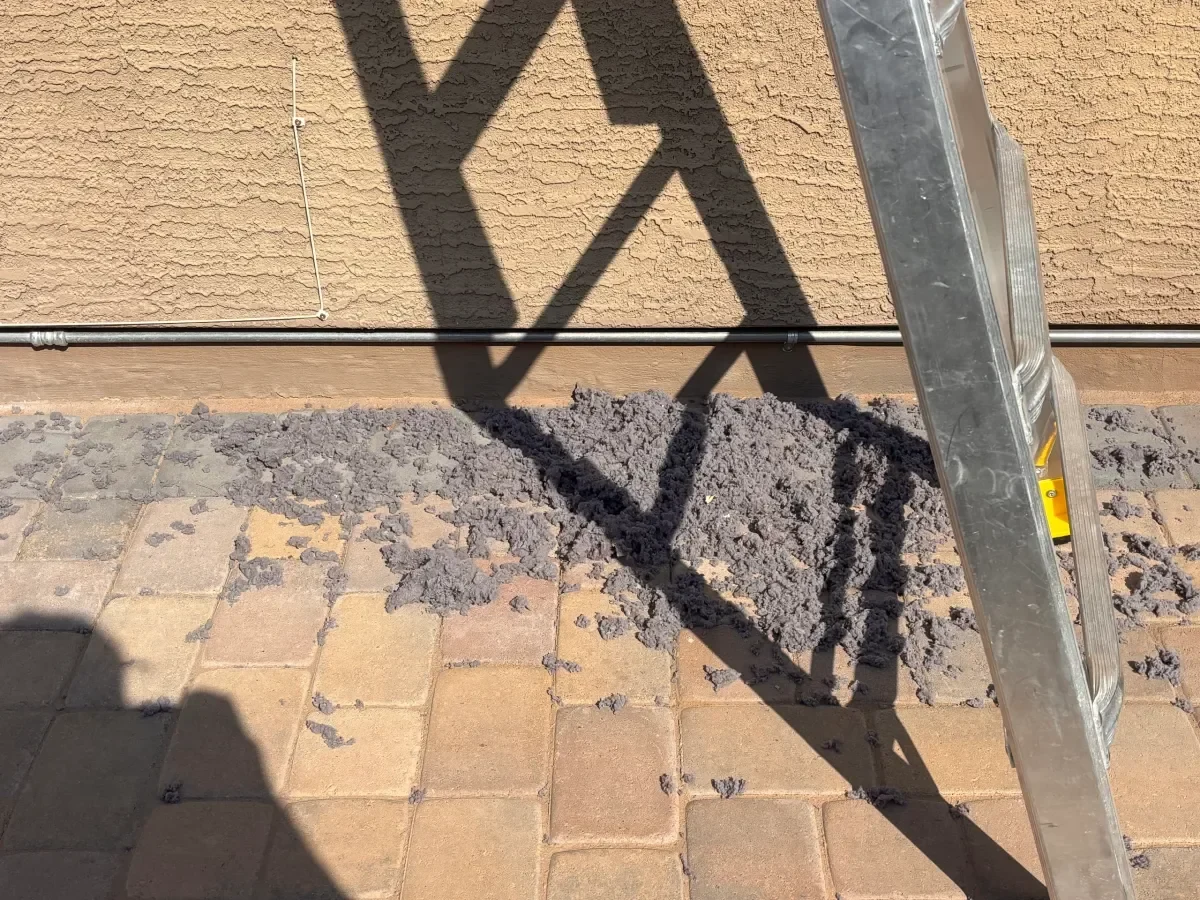
- Outside first, machine running. The dryer stays powered up the entire time we are at the termination, so its own exhaust pushes whatever we loosen out and clear of the duct instead of letting it settle back into the run. It throws lint around outside. Clearing that up is part of the job.
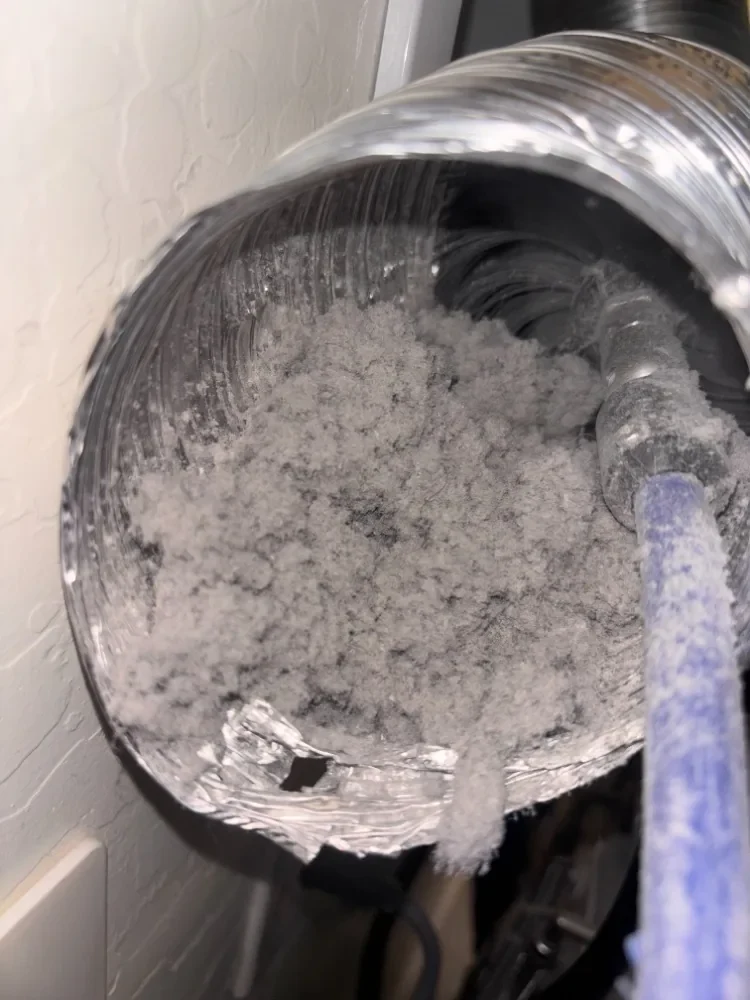
- Then inside. Power off, hose uncoupled, appliance drawn away from the wall. The brush goes into the vent from this end, the freed material comes down toward us, and the vacuum takes it out of the cavity.
- Two ends when the run earns it. A long route with several bends gets worked from both directions, since a brush entering from one side never properly reaches the far half. A short straight run does not, and we will say so instead of inventing work.
- Back together, and you look at it. Appliance reconnected and run, and the material we pulled out left in front of you.
How often it needs doing
Ten months is the interval for an ordinary household. Treat that as a maintenance schedule rather than a nudge.
- Every 10 months in a typical Ahwatukee home
- Every 4 to 6 months where the house is full and the machine runs most days
- Monthly on commercial equipment
Plenty of people here treat a slow dryer as the cue to call somebody. By then you are not approaching the interval, you went past it roughly a year ago. Slow drying is what surfaces after months of restricted airflow have already been working on the appliance, not the point at which the problem starts.
What it costs
| Service | Price | What it is |
|---|---|---|
| Standard dryer vent cleaning | $99 | Full run, brushed from both ends where it is needed. Roof or side wall, any story. |
| Lint trap housing clean | +$98 | Optional, and the one we actually argue for. |
| Hose upgrade | +$98 | Optional. Foil flex replaced with rigid transition duct. |
The extra we do push. Beneath your removable lint screen is a cavity that nothing empties and most owners have never had opened. We have taken apart machines where it had never been cleared once, and putting right what running that hot had done came to more than the dryer was worth replacing. Worth reading before you skip it.
Where we work
The Foothills · Lakewood · Mountain Park Ranch · Club West · Foothills Reserve · Calabrea · Equestrian Trails · Ahwatukee Custom Estates · Canyon Views · Tapestry · The Presidio · Sunrise Foothills · Mountain Vista Ranch · Desert Foothills Estates · Cottonwoods · Sandpiper · Lakewood Estates
The Foothills and Lakewood · Mountain Park Ranch · Club West · Original Ahwatukee · Foothills Reserve and Calabrea · Ahwatukee Custom Estates and the hillside lots
Common questions
What does dryer vent cleaning cost in Ahwatukee?
$99 flat for a standard vent, roof terminations included. Two optional extras at $98 each: clearing the lint trap housing, and swapping foil flex for rigid transition duct. Most people take the $99 on its own, though we do make the case for the housing clean more firmly than the other one.
Is roof access genuinely not extra?
It is not. Most two-story homes in the Foothills send their exhaust out through the roof, so charging separately for it would mean surcharging a large share of the village over how their house was built.
Do you cover all three zip codes?
85044, 85045 and 85048, all at the same price. The village is compact and geographically self-contained, so pricing by zone would be billing you for our drive rather than for anything you receive.
How long does it take?
Between 45 and 90 minutes for most Ahwatukee homes. Short single-story side-wall runs are quick. Long roof runs with several bends take longer, and a nest adds time on top.
How often should it be done?
Ten months in an ordinary household, four to six where the house is full or dust exposure is heavy, monthly on commercial equipment. If the dryer going slow is your cue to ring somebody, you are already about a year past due.
Do you work outside Ahwatukee?
No. Ahwatukee Foothills only, which is why we already know how the hillside lots in the custom estates behave and what the dust does to homes backing the old Club West course.
Card accepted?
Yes, and we can email or text a receipt.
Calls answered 7am to 8pm · same-day service usually available
$99 flat with roof access included. Phone answered 7am to 8pm.